
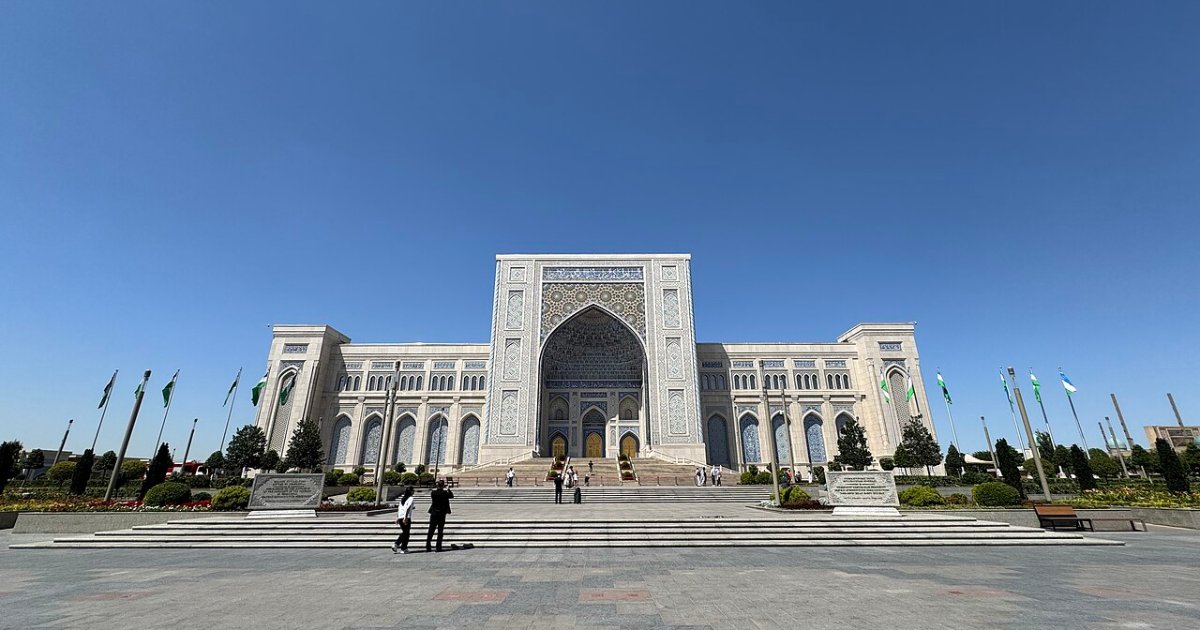
The Center of Islamic Civilization in Tashkent is Uzbekistan's biggest new attraction: a 65-metre dome, the 7th-century Quran of Uthman and a museum of world science. Here is what is inside and how to fit it into your trip.
In this article
What it is and why it was built
The Center of Islamic Civilization is not a mosque and not a memorial. It is a large museum and research complex devoted to Central Asia's contribution to world science and culture. The idea is simple and bold: to show that between the 9th and 15th centuries the lands of today's Uzbekistan were one of the planet's main intellectual centres — home to al-Khwarizmi, Ibn Sina (Avicenna), al-Biruni, al-Bukhari and Ulugh Beg.
The project was approved in 2017 and took almost a decade to build. Its location is the Hazrati Imam complex, Tashkent's historic religious quarter, next to the Barak Khan Madrasah and the Tilla Sheikh Mosque. That choice was deliberate: this quarter has guarded Uzbekistan's most precious relic — the world's oldest surviving Quran manuscript — for decades.
For travellers it means one thing: Tashkent now has a landmark worth a full day, instead of being a city you fly through on the way to Samarkand.
The architecture: dome, four portals, light

You recognise the building instantly. Its central dome rises around 65 metres — the tallest dome in modern Uzbek architecture, higher than the famous domes of Samarkand and Bukhara. From the inside it behaves like a sky: daylight filters through openwork screens and paints patterns on the walls that shift through the day.
The layout follows a classic Eastern principle: four monumental portals (pishtaqs) on four sides, as in the madrasahs of the Registan. The execution, though, is contemporary — concrete, glass and engineered lighting — while the decoration is handmade: carved ganch plaster, majolica tiles and calligraphy produced by craftsmen from Rishtan, Khiva, Bukhara and Tashkent.
What to look for
- The space under the dome — step in and look up; this is the building's main visual moment.
- The girih geometry on the portals: the same motif repeated at different scales.
- The calligraphic friezes, written in several historical scripts.
The Quran Hall and the Uthman manuscript

The heart of the complex is a hall built around a single book: the Quran of Uthman (Mushaf of Uthman), one of the oldest surviving Quran manuscripts, dated to the 7th century. It is written on parchment in Kufic script without vowel marks — close to the form in which the text was recorded under the third caliph.
Its journey reads like a novel: from Medina to Iraq, then, by tradition, to Samarkand; to St Petersburg in the 19th century; and back to Tashkent in 1924. For decades it sat in a small display case in the library of the Muyi Muborak Madrasah in this same Hazrati Imam quarter, not easy to reach. Now the manuscript has a dedicated hall with museum-grade climate control and proper lighting.
Keep in mind that this is a living sacred object for Muslims worldwide and one of humanity's most significant written monuments. Visitors are asked to stay quiet, avoid flash photography and keep a respectful distance from the case.
Inside: from Sogdiana to the Square of Tolerance
The exhibition is built as a journey through time, and that structure helps even visitors who know nothing about the region's history.
Pre-Islamic Central Asia
A hall on Sogdiana, Bactria and Khorezm: Zoroastrianism, Buddhist monasteries, Nestorian Christians, caravan trade. It makes clear what cultural ground Islam arrived on, and why the region was always so layered.
The golden age of science
The 9th to 11th centuries: algebra and the very word "algorithm" (from al-Khwarizmi), Ibn Sina's Canon of Medicine, al-Biruni's geography and astronomy, al-Bukhari's hadith collections. Reconstructed instruments, manuscripts and maps.
The Timurid Renaissance
The 14th and 15th centuries: Amir Temur's Samarkand, Ulugh Beg's observatory and star catalogue, the art of the book, miniature painting and architecture. Excellent context before Samarkand and Shakhrisabz — you will look at the Registan differently afterwards.
The Square of Tolerance
A separate space on how Muslims, Jews (the Bukharan Jewish community), Christians and others have lived side by side here for centuries. For many guests it is the most unexpected part of the visit: it explains the country's present-day atmosphere better than any guidebook.
The library and research centre
The Center is more than a museum. It houses a library of roughly 3,105 square metres with tens of thousands of books and digitised manuscripts, plus rooms for researchers, a conference hall and restoration laboratories. For an ordinary visitor the library is worth seeing as a space: tall reading rooms, study desks, cases with manuscript facsimiles. If you came to Uzbekistan to understand it rather than just photograph it, you can happily spend an extra hour here.
Getting there and when to go

The Center stands in north-western Tashkent, inside the Hazrati Imam complex (Sebzar district). Nearby landmarks: the Hazrati Imam Mosque, the Barak Khan Madrasah and the Kaffal Shashi Mausoleum.
- Taxi. The easiest option: 15–25 minutes from the city centre, and ride-hailing apps cover all of Tashkent.
- Metro. The closest stations are around Chorsu / Gafur Gulyam, then a 10–15 minute walk or a short taxi hop.
- On foot. If you are already exploring Hazrati Imam or Chorsu Bazaar, the complex fits naturally into the same walk.
Check opening hours and access conditions shortly before your visit: the complex is new, schedules and rules for individual halls can change, and parts of it close during official events. We always verify this for our guests the day before a tour.
Please note: museum and monument entrance tickets are not included in our tour packages and are paid on site. That way you only pay for the places you actually decide to visit.
One day in Tashkent: a ready-made route

The Center works best as the opening act of the day — context first, then the living city.
- Morning. The Hazrati Imam complex: the Center of Islamic Civilization (1.5–2 hours), then the Barak Khan Madrasah and Hazrati Imam Mosque next door.
- Midday. Chorsu Bazaar under its blue dome: spices, dried fruit, tandoor bread. Lunch — plov or shurpa in a nearby chaikhana.
- Afternoon. Tashkent's metro stations as an underground mosaic museum, then Amir Temur Square and the Museum of Applied Arts.
- Evening. A walk along Navoi Avenue, dinner with a view of the floodlit TV tower, and optionally a concert or a look at Tashkent City park.
This day slots perfectly in front of the classic Tashkent – Samarkand – Bukhara – Khiva route: you start with why all of it matters, then see it standing in front of you along the Silk Road. Browse our Uzbekistan tours — we build the itinerary around your dates.
Practical tips
- Dress. There is no strict dress code for the museum itself, but Hazrati Imam is a religious quarter. Covered shoulders and knees are appropriate, and women should carry a scarf for the neighbouring mosques.
- Photography. General spaces are usually fine; the Quran Hall is restricted. Never use flash. Check the rules at the entrance and with hall attendants.
- Time. Allow at least 1.5 hours, or 2–2.5 with the library. For the best light on the facade, come in the morning or near sunset.
- Guide. The exhibition is dense and largely about ideas rather than objects. With a guide or audio guide you will take away far more, especially on a first visit to Central Asia.
- Children. Suitable from around age 10–12: plenty of visual reconstructions, but little in the way of play.
- Don't overload the day. Skip the idea of three more museums. One strong site plus a bazaar and a teahouse stays with you longer than six ticked boxes.
Want to see it with a guide?
We are a local destination management company based in Tashkent, working with guests from around the world every day. We will plan the route, arrange a guide in your language and comfortable transport, and confirm opening hours before your visit.
Message us on WhatsApp: +998 99 939 91 11
Phone and Telegram: +998 99 939 91 11 · Website: okstours.com
Oks DMC | Oks Tours Team